- Bonus value = face value minus expected cost (stakes needed × (100% − RTP)), limited by the withdrawal cap.
- Shortcut: cost as a share of the bonus = multiplier × house edge ÷ contribution. At 96% RTP, 10x costs 40% of the bonus and 25x is break-even.
- A £50 bonus at 10x on bonus only costs about £19 to clear on Book of Dead's 96.21% setting, but is worth about £6 on its 91.25% setting.
- Since 19 January 2026, UK-licensed operators cannot require more than 10x wagering, but contribution rates, the wagering base and cashout caps still decide the real value.
- In our offer data, a £1,000 headline with a £50 conversion cap is worth far less than it looks.
How to calculate casino bonus value comes down to one sum: the bonus’s face value, minus what it costs on average to clear the wagering, limited by what the terms let you withdraw. Most players stop at the first number. The offers that look biggest are often the ones that give back the least.
This guide gives you the five-step sum, a one-line shortcut for checking an offer in seconds, and then prices real welcome offers from our own offer data on identical assumptions so they can be compared fairly.
How to calculate casino bonus value in five steps
The value of a bonus is its face value minus the expected cost of the play needed to release it, never more than the withdrawal cap. Work through these steps in order, using one currency throughout.
- Fix the bonus from your real deposit. A 100% match on a £50 deposit gives £50, not the advertised maximum. The cap is a ceiling, not a promise.
- Find the wagering base and multiply. Wagering (also called playthrough) is the amount you must stake before bonus funds or winnings become withdrawable. Multiply the base, which may be the bonus alone or deposit plus bonus, by the multiplier.
- Adjust for game contribution. Contribution is the share of each stake that counts towards the target. Divide the turnover by the contribution rate to get the real stakes needed.
- Price the play. Expected cost = stakes needed × (100% − RTP). RTP, return to player, is the long-run average share of stakes a game pays back.
- Apply the limits. Check the maximum bet, the expiry window and any cap on what you can withdraw. Subtract expected cost from face value, then cut the result down to the cap if the cap is lower.
Take a £50 bonus with 10x wagering on the bonus only, played on slots that count 100% at 96% RTP. Turnover is £500, expected cost is £500 × 4% = £20, and expected value is £50 − £20 = £30. That is 60p of value for every £1 of headline bonus.
That £30 is an average, not a forecast. A balance can hit zero before the wagering is done, so the real-world figure is lower, and any single attempt can finish well above or below it.
Averages only. Real results vary widely, especially on high-volatility games. Casinos often exclude some games from wagering or count them at a lower rate. Check the offer’s full terms. 18+.
Low volatility, high RTP
Ready slots with volatility Low or Low-Medium, sorted by RTP, not blocked in United States. Tap one to use its RTP.
Our Bonus Wagering Calculator runs steps two to four for you: enter the bonus, deposit, multiplier, stake and RTP, and it returns turnover, expected cost and spins needed.
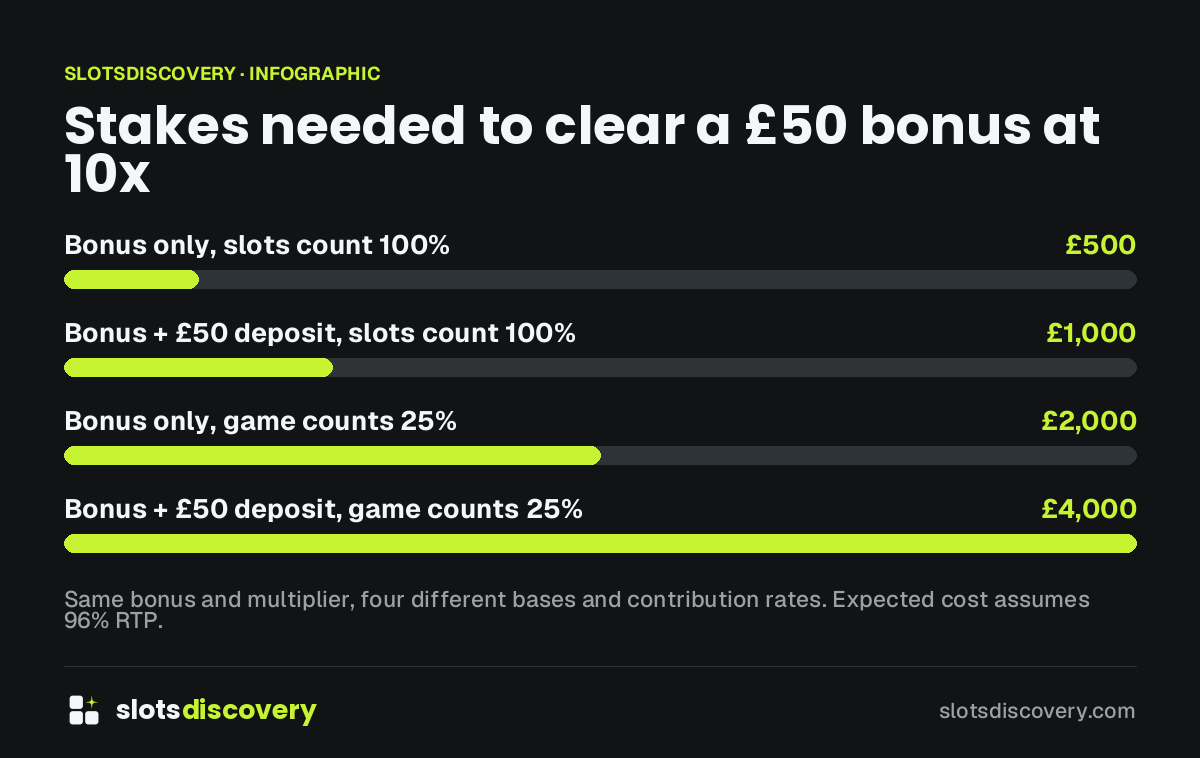
Same bonus and multiplier, four different bases and contribution rates. Expected cost assumes 96% RTP.
 Save or share this infographic
What is the quick formula for judging a bonus?
Expected cost as a share of the bonus = wagering multiplier × house edge ÷ contribution. At 96% RTP the house edge is 4%, so every 1x of wagering on the bonus alone costs 4% of the bonus.
| Wagering on the bonus | Cost as % of bonus (96% RTP, 100% contribution) | Cost on a £50 bonus | Verdict |
|---|---|---|---|
| 5x | 20% | £10 | Strong |
| 10x | 40% | £20 | Positive on average |
| 20x | 80% | £40 | Barely worth the effort |
| 30x | 120% | £60 | Costs more than it gives |
| 40x | 160% | £80 | Negative on average |
The break-even multiplier on a bonus-only base is 25x at 96% RTP, because 25 × 4% = 100%. Before the British cap, 30x to 50x offers were common, according to casinos.co.uk’s guide to the cap, which is why large-looking bonuses so often had negative average value.
If the base is deposit plus bonus, scale the cost up. A £50 deposit with a £50 bonus at 10x on both is £1,000 of turnover, which is 80% of the bonus, not 40%.
Does the 10x wagering cap change the maths?
In Great Britain, yes: since 19 January 2026 licensed operators cannot attach wagering of more than 10x the bonus, according to AskGamblers’ report on the rules coming into force. It sits in Social Responsibility Code provision 5.1.1 and arrived alongside a ban on offers that mix products, such as a sports bet unlocking casino spins. It lowers the worst case, but it does not make every offer equal.
The cap limits the multiplier, not the contribution rate or the withdrawal limit. A 10x requirement on a game that counts 10% still means staking ten times more than the target to clear it. Outside Great Britain the UK cap does not apply, so check the base and the multiplier line by line.
The base matters more than most players expect. The Behavioural Insights Team found that 7 in 10 people could not work out how much they would need to bet to meet a requirement, rising to almost 9 in 10 when it applied to bonus plus deposit.
How does game weighting change the cost?
Lower contribution multiplies the stakes you need and therefore the expected cost. It can turn a positive offer into a negative one without the multiplier changing.
Take a £100 bonus at 10x on the bonus only, with a 96% RTP game. At 100% contribution you stake £1,000 and expect to lose £40, so the offer is worth about £60. At 50% contribution you stake £2,000, expect to lose £80, and the value drops to about £20.
The practical fix is to play the highest-RTP game that counts in full. Our guide to the top slots to clear a casino bonus with lists candidates, and the terms will show excluded games and the maximum bet while the bonus is active.
Which RTP should you use in the sum?
Use the RTP of the exact version your casino runs, not the figure on the review page. Some studios supply the same game at several RTP settings, and the operator picks one.
Play’n GO’s Book of Dead is the clearest case. Its headline RTP is 96.21%, but OLBG lists lower settings of 94.25%, 91.25%, 87.25% and 84.18%, and the paytable inside the game shows which one you are playing. Here is what that does to a £50 bonus at 10x on the bonus only, which needs £500 of stakes:
| Book of Dead setting | House edge | Expected cost of £500 stakes | Average value of a £50 bonus |
|---|---|---|---|
| 96.21% | 3.79% | £18.95 | £31.05 |
| 94.25% | 5.75% | £28.75 | £21.25 |
| 91.25% | 8.75% | £43.75 | £6.25 |
| 87.25% | 12.75% | £63.75 | −£13.75 |
The same bonus, the same wagering and the same game swing from £31 of average value to a loss. Check the information screen before you spin, and use our RTP Calculator to see what any setting means per £100. To start from games with strong published figures, see our list of top high-RTP slots.
How do real welcome offers compare?
Priced on the same assumptions, offers with similar headlines can differ sharply once caps and conditions are counted. The table uses terms listed in our offer data for UK players, with slots at 100% contribution, 96% RTP and wagering on the bonus only.
| Offer | Wagering | Per £100 of bonus: turnover / expected cost | What limits the value |
|---|---|---|---|
| Betsuna: 100% up to £100 + 50 spins | 10x | £1,000 / £40 | Min deposit £10 (£20 for some payment methods); spins on Bigger Bass Splash |
| JeffBet: up to £100 + 50 spins | 10x bonus, 10x spin winnings | £1,000 / £40 | Real balance is wagered first; max conversion £500; withdrawing voids pending bonuses |
| Spinzwin: up to £1,000 + 100 spins | 10x bonus, 10x spin winnings | £1,000 / £40 | Max conversion £50 from bonus, £20 from spins; 30 days for the bonus, 7 for spin winnings |
| Monster Casino: up to £1,000 + 100 spins | 10x bonus, 10x spin winnings | £1,000 / £40 | Same £50 and £20 conversion caps; selected games only; min deposit £20 |
| Kwiff: 200 spins at £0.10 | None on winnings | Not applicable: £20 of spins | Wager £20 on slots within 5 days; max withdrawal £250; e-wallets and virtual cards excluded |
The £1,000 headline at Spinzwin and Monster Casino is the lesson. Our data lists a £50 maximum conversion from the bonus, so the maths suggests £60 of average value per £100 of bonus but the terms cap what you can take at £50. Past that point, a bigger bonus adds wagering without adding cashable value.
JeffBet’s “real balance is wagered first” line matters too. It means your own cash is staked before bonus funds, so the bonus is only at risk if you lose the cash first. That is generally friendlier than a bonus that is spent first, but check how the operator defines it.
Kwiff works differently. The 200 spins at £0.10 carry £20 of stake value, and at Book of Dead’s 96.21% default they return about £19.24 on average with no wagering on the winnings. The £20 qualifying slot wager costs about £0.76 on average, so the estimated value is around £18.50, with the £250 withdrawal limit as the ceiling. Book of Dead is high volatility, so actual results will swing far more than that average, and a lower RTP setting would reduce the figure.
Offer terms change often and these are listed for GB players only. Use the live offers below for your country, then run each one through the five steps.
No offers of this type for United States right now. See every casino bonus.
Top mistakes that make a bonus look better than it is
Most overvaluation comes from six things the headline hides. Each one is visible in the terms before you deposit.
- Ranking by size. A £1,000 offer with a £50 conversion cap can be worth less than a £100 offer with a £500 cap.
- Ignoring the second clock. In our data, several offers give 30 days for the bonus but only 7 days to wager spin winnings.
- Breaking the maximum bet. A per-spin limit is typical, and casinos.co.uk puts it at £2 to £5. Going over it can void the bonus, so check it before raising your stake.
- Withdrawing early. JeffBet’s listed terms say a withdrawal voids pending bonuses, so cashing out mid-wagering can forfeit the bonus.
- Using an excluded payment method. Skrill and Neteller deposits are excluded from several offers, and Kwiff excludes e-wallets and virtual cards.
- Treating turnover as loss. Turnover is total staked, not money lost. Expected cost, stakes × (100% − RTP), is the number to compare.
Stake size is the lever you control. Spins needed = turnover ÷ stake, so £500 of wagering is 1,000 spins at £0.50 or 250 at £2. The average cost is the same, but smaller stakes spread the variance and make a bust before the target less likely, provided the game still counts in full.
If you would rather skip the sum entirely, wagering-free casino bonuses remove steps two to four, although caps can still apply.
A quick way to decide before you claim
Run the five steps for each offer on the same deposit, game contribution and RTP, then compare expected value and the withdrawal cap rather than the headline. If expected cost is higher than the bonus, or the cap is lower than the value, skip it.
Browse top casino bonuses, priced and compared for more offers worked out the same way. The arithmetic is the same whatever your currency, as long as the deposit, bonus, stake and cap are all in one.
Questions people ask
How do you calculate the value of a casino bonus?
Work out the turnover (wagering base × multiplier, adjusted for game contribution), multiply stakes by (100% − RTP) to get expected cost, then subtract that from the bonus. Cap the result at any maximum withdrawal or conversion limit.
How do you work out the expected cost of wagering?
Multiply the total stakes needed by the house edge, which is 100% minus the game's RTP. At 96% RTP, £1,000 of stakes costs about £40 on average.
Is a bonus with 10x wagering worth it?
It can be. A £50 bonus at 10x bonus-only on a 96% RTP slot that counts 100% has an average value of about £30. It stops being worth it if contribution is low, the base includes your deposit, the game runs a lower RTP setting, or a cashout cap sits below that value.
What is the break-even wagering requirement?
On a bonus-only base with 100% contribution, break-even is 100% divided by the house edge. At 96% RTP that is 25x, so anything above 25x costs more than the bonus on average.
What does max conversion mean in a casino bonus?
It is the most you can turn from bonus funds or free-spin winnings into withdrawable cash. If the cap is £50, anything above that is removed even if you complete the wagering.
Does wagering apply to my deposit as well as the bonus?
It depends on the terms. In Great Britain the 10x cap applies to the bonus amount, but outside it some offers apply the multiplier to deposit plus bonus, which roughly doubles the turnover at the same multiplier.