- Low vs high volatility slots differ in how prizes are spread over many spins. They never change the odds of the next spin.
- At the same RTP, every £100/€100/$100 staked returns the same long-run average. Volatility sets how bumpy the route is: in our worked example, about three times the swing.
- Budget in spins, not pounds: £100 at 40p is 250 spins, and a feature that lands once per 250 spins on average still misses in about 37% of 250-spin sessions.
- A big max win is a ceiling, not a likelihood. At 20p a spin, Mental 2's 99,999x is £19,999.80; at £1 it is £99,999.
- Labels are each studio's own. Gates of Olympus 1000 is 'very high' in our review and 'high' elsewhere, and its RTP can be 96.50%, 95.51% or 94.50% depending on the casino.
Low vs high volatility slots differ in how prizes are spread across many spins: low volatility tends to pay smaller amounts more often, high volatility pays larger amounts less often. Neither changes the odds of the next spin, and neither changes what the game returns over the very long run.
What is the difference between low and high volatility slots?
Volatility (also called variance) is the spread of a slot’s payouts around its average return. Low volatility clusters outcomes close to that average, so wins are frequent and small. High volatility stretches them out, with long quiet runs and occasional large prizes.
Mathematically it is the standard deviation of the payout distribution: how far single outcomes typically stray from the RTP. As one volatility guide puts it, volatility does not change what a game pays in aggregate, only how those payouts arrive.
| Profile | What it feels like | Dry spells | Typical ceiling | Where the return comes from |
|---|---|---|---|---|
| Low volatility | Frequent small returns, many close to your stake | Short | Hundreds of times stake | The base game |
| Medium volatility | A mix of small returns and the odd bigger hit | Moderate | Low thousands to 10,000x | Base game and bonus round |
| High / very high volatility | Many losing spins, then a feature or big win carries the session | Long | Thousands to hundreds of thousands | Mostly the bonus round and top multipliers |
Browse each end of the scale in our top low volatility slots list, then compare it with the high-volatility equivalent further down this page.
Does volatility change the odds of the next spin?
No. Every spin is an independent random result, so a run of losses does not make a win due, and a recent win does not make the next one less likely. Volatility describes the pattern over thousands of spins, not what happens on spin 51.
A hit is any spin that returns a prize, and hit frequency is the share of spins that do. A hit is not a profit: stake £1, receive £0.40, and the spin counted as a hit while your balance fell by £0.60.
That is why hit frequency alone misleads. A game can hit often and still be high volatility if most hits are below your stake and a few huge prizes make up the return.
What does the same RTP look like at low and high volatility?
RTP (return to player) is the average share of stakes a game returns over a very large number of spins. At 96%, every £100 staked returns £96 on average and costs £4, whether the slot is low or high volatility.
The difference is the spread around that average. Take 1,000 spins at £1 (£1,000 staked) on a 96% RTP game: the expected result is a £40 loss. Session spread grows with the square root of the spin count, so one standard deviation is the per-spin figure times √1,000, about 31.6. The per-spin figures below are our assumptions, not data for any named game.
- Low-volatility example (standard deviation of 3x stake per spin): about ±£95. Roughly two sessions in three would finish between a £135 loss and a £55 gain.
- High-volatility example (10x stake per spin): about ±£316. The same two-in-three range runs from a £356 loss to a £276 gain.
Treat those as a guide to scale, not a forecast. High-volatility results are lopsided: many sessions finish below the average and a few finish far above it, so a simple bell-curve range understates how often you land low and how big the highs get. The simulator shows that lumpiness over 1,000 spins.
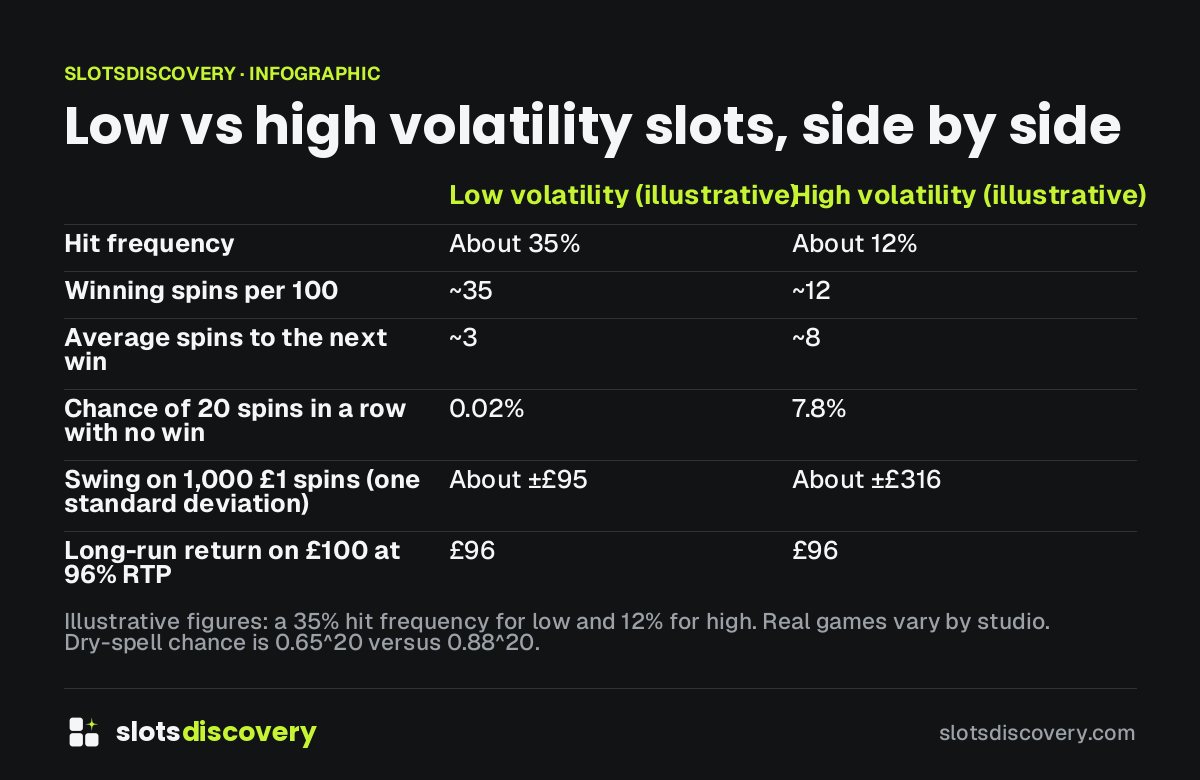
| Low volatility (illustrative) | High volatility (illustrative) | |
|---|---|---|
| Hit frequency | About 35% | About 12% |
| Winning spins per 100 | ~35 | ~12 |
| Average spins to the next win | ~3 | ~8 |
| Chance of 20 spins in a row with no win | 0.02% | 7.8% |
| Swing on 1,000 £1 spins (one standard deviation) | About ±£95 | About ±£316 |
| Long-run return on £100 at 96% RTP | £96 | £96 |
Illustrative figures: a 35% hit frequency for low and 12% for high. Real games vary by studio. Dry-spell chance is 0.65^20 versus 0.88^20.
 Save or share this infographic
What do real low, medium and high volatility games look like?
The clearest real-world difference is the ceiling. The table uses our review data for each game and shows what the top prize is worth at 20p and at £1 a spin; the multiples are identical in euros or dollars.
| Game (studio) | Our volatility label | Max win | At 20p a spin | At £1 a spin |
|---|---|---|---|---|
| Aviamasters (BGaming) | Low | 250x | £50 | £250 |
| Fortune Tiger (PG Soft) | Medium | 2,500x | £500 | £2,500 |
| Mahjong Ways (PG Soft) | Medium | 2,893x | £578.60 | £2,893 |
| Le Bandit (Hacksaw Gaming) | Medium | 10,000x | £2,000 | £10,000 |
| Legacy of Dead (Play’n GO) | High | 5,000x | £1,000 | £5,000 |
| Chaos Crew II (Hacksaw Gaming) | High | 20,000x | £4,000 | £20,000 |
| Gates of Olympus 1000 (Pragmatic Play) | Very high | 15,000x | £3,000 | £15,000 |
| Fire in the Hole 3 (Nolimit City) | Very high | 70,000x | £14,000 | £70,000 |
| Mental 2 (Nolimit City) | Very high | 99,999x | £19,999.80 | £99,999 |
| Tombstone RIP (Nolimit City) | High | 300,000x | £60,000 | £300,000 |
Read the table for the pattern, not the prizes. The ceiling is not the likelihood: the higher it is, the rarer it must be for the RTP to hold. Tombstone RIP is labelled high in our data despite a 300,000x ceiling, which shows how loosely the labels map to the numbers.
Now a game in our database. 3 Kingdoms of Fortune – Xtreme Power Pots from Rival Powered is listed as high volatility with a 96.23% RTP, a 50,000x max win and free spins, released on 15 January 2026, with no bonus buy.
At 20p a spin, 50,000x is £10,000; at £1 it is £50,000. On the 96.23% RTP, every £100 staked returns £96.23 on average, a £3.77 cost. Our max-win reality check converts any game’s top prize at your stake.
How much budget does each volatility need?
Budget divided by stake gives the number of spins you can afford, and high-volatility games need more spins to reach the round they are built around. The table uses a £100 budget and a rule of thumb of one bonus trigger per 250 spins.
| Stake | Spins from £100 | Expected bonus triggers (1 in 250) |
|---|---|---|
| £1 | 100 | 0.4 |
| 50p | 200 | 0.8 |
| 40p | 250 | 1 |
| 20p | 500 | 2 |
| 10p | 1,000 | 4 |
The 250 figure comes from a guide that suggests 200 to 500 or more spins to reach the expected bonus on high and very high volatility slots. Individual games differ, so treat it as a planning number.
Averages hide the bad runs. If a feature lands with a 1-in-250 chance per spin, the chance of seeing none in 250 spins is about 37%, and in 500 spins about 14%. At £1 a spin, a £100 budget is 100 spins away from that average, which is the most common high-volatility mistake: the stake is too big for the game, not the game too wild for the player.
Our bankroll calculator sizes a budget to a game’s volatility, and the session calculator shows how long it lasts on average.
Why do volatility labels differ between studios?
Because there is no industry standard: each studio rates its own games on its own scale. Pragmatic Play uses a 1-5 scale and Nolimit City uses 1-10, according to OLBG’s volatility guide, which also notes that Nolimit City added an ‘insane’ tier with Mental in August 2021.
The practical effect is that the same game can carry different labels. Our review calls Gates of Olympus 1000 very high volatility, while SiGMA World’s review describes it as high. The game is the same; the scale and the reviewer differ.
Hit frequency does not settle it either. A published comparison reports Hacksaw Gaming’s Le Viking as medium volatility at about 38% hit frequency, and Chaos Crew 3 from the same studio as high at about 31%. Rough rules of thumb put low volatility at around 30% hit frequency or more and high at 10 to 20%, but studios blur those lines.
So read three numbers together: the label, the max win and the hit frequency or bonus frequency if the studio publishes it. Our slot feature dictionary explains the features that push a game up the scale.
Is volatility the same as RTP?
No. RTP is the average return and volatility is the spread around it, so they answer different questions. Two slots can share a 96% RTP and play very differently, and a higher RTP does not mean lower volatility.
The bigger trap is that RTP itself can change by casino. SlotCatalog lists Gates of Olympus 1000 at 96.50%, 95.51% or 94.50%, depending on the operator’s setting. Per £100 staked, the expected cost is £3.50 at 96.50% and £5.50 at 94.50%, which is about 57% more. Over £1,000 of spins that is £20 less returned, the same on a low or high volatility game.
Check the RTP in the game’s info screen before you play, then rank slots by RTP separately from volatility.
Which volatility suits bonus wagering?
Low to medium volatility usually gives you the best chance of reaching the end of a wagering requirement, because balance swings are smaller. It does not change the expected cost, which is set by RTP.
Here is a hypothetical: a £100 bonus with 35x wagering on the bonus alone is £3,500 of turnover. At 96% RTP the expected loss across that turnover is £140, which is more than the bonus itself, so many attempts end before the requirement is done. A high-volatility game makes the early bust more likely and the occasional big clear more likely too. Always check any stake cap in the terms, and price it with the bonus wagering calculator.
For game ideas, see our monthly list of top slots to clear a casino bonus with.
Best volatility for your budget and goal
Pick low volatility for longer sessions on a small budget, and high volatility only when your stake is small enough to afford hundreds of spins. Medium suits most players who are not sure.
| Your goal | Volatility to start with | Stake rule |
|---|---|---|
| Make a small budget last | Low to medium (for example Aviamasters or Fortune Tiger) | Budget ÷ 200 or more |
| Chase a bonus round with some balance | Medium to high (for example Le Bandit or Legacy of Dead) | Budget ÷ 250 |
| Go for a huge ceiling | High to very high (for example Mental 2 or Fire in the Hole 3) | Budget ÷ 500, and accept most sessions end low |
Then work it through in four steps:
- Set the budget first. Decide what you will spend in your currency, then work backwards to a stake.
- Convert the ceiling. Multiply max win by your stake and judge whether that number is realistic for you ever to see.
- Check the RTP version. Open the info screen on the casino you use; do not rely on a review site’s figure.
- Shortlist, then test. Our current top-scoring low and high volatility games are below, and a short demo run says little about either.
3 Coin Treasures 2
- RTP
- 97.00%
- Volatility
- Low-Medium
- Max win
- 10,400x

Piggy Bank Hold & Win
- RTP
- 96.98%
- Volatility
- Low-Medium
- Max win
- 2,500x


- RTP
- 96.02%
- Volatility
- High
- Max win
- 10,000x
Sleeping Dragon Ultra Dark
- RTP
- 96.50%
- Volatility
- High
- Max win
- 20,000x

Mummy’s Jewels 100
- RTP
- 96.52%
- Volatility
- Very High
- Max win
- 30,000x
- RTP
- 96.70%
- Volatility
- Very High
- Max win
- 20,000x

The full ranked lists are on our top high volatility slots page, and our guide on how to play high volatility slots covers stakes in more detail.
This tool is coming soon.
In short: volatility tells you how the same average return gets delivered, not whether the next spin will pay. Size your stake to the game in spins, read the ceiling in your own currency, and check the RTP version before you start.
Questions people ask
What is the difference between low and high volatility slots?
Low volatility slots tend to pay smaller prizes more often, while high volatility slots pay larger prizes less often, with longer dry spells. Both return the same long-run average if their RTP matches.
Do high volatility slots pay more?
Not over the long run: that is set by RTP, not volatility. High volatility games pay bigger amounts when they hit, but they hit less often.
Is low volatility better for a small budget?
Often, because smaller and more frequent returns usually mean gentler swings and more spins from the same money. It does not remove losing spins or guarantee a profit.
Does a losing streak mean a win is due?
No. Each spin is independent, so past results do not make a win more likely on the next one.
Why does the same slot show different volatility on different sites?
There is no industry standard, so studios and reviewers use their own scales and labels. Compare max win, bonus frequency and RTP alongside the label.
What hit frequency is low volatility?
Reviewers often put low volatility at around 30% or more and high volatility nearer 10 to 20%. These are rough guides, since studios define volatility differently.